

Meat inspection is mandatory in the United States. Learn who inspects our meat, what they look for, and what happens when meat is approved (or not approved).

Let’s talk about meat inspection. It’s not a very glamorous topic, but it’s very important since everyone wants their food to be safe to eat.
Is meat inspection mandatory in the U.S.?
Yes. Meat inspection is mandatory in the United States. The Federal Meat Inspection Act (FMIA) of 1906 requires that all meat sold commercially be inspected and passed to ensure that it is safe, wholesome, and properly labeled. The United States Department of Agriculture (USDA) Food Safety and Inspection Service (FSIS) is responsible for providing this federal inspection. The USDA FSIS inspects all raw meat and poultry sold in interstate commerce and foreign commerce, including imported products.This includes any product intended for human consumption from any cattle, sheep, swine, goat or chicken. USDA’s Food Safety and Inspection Service (FSIS) is responsible for ensuring the safety and wholesomeness of meat, poultry, and egg products and ensures that it is accurately labeled.
In addition, the FSIS enforces the Federal Meat Inspection Act (FMIA), the Poultry Products Inspection Act (PPIA), and the Egg Products Inspection Act. These laws require Federal inspection and regulation of meat, poultry, and egg products prepared for distribution in commerce for use as human food. It also verifies compliance with the Humane Methods of Slaughter Act for livestock. This statute is enforced through the FMIA.
Jump to:
- Is meat inspection mandatory in the U.S.?
- What is the purpose of meat inspection?
- Who inspects meat in the U.S.?
- Federal Inspection vs. State Meat Inspection
- What does USDA inspected meat mean?
- Meat inspection’s (edible) stamp of approval
- Grading Beef: Prime, Choice & Select
- How are beef grades determined?
- What beef grades do not mean
What is the purpose of meat inspection?
Meat and poultry products are an integral part of the food chain, but they can also be associated with food borne diseases. Ensuring quality standards and that products are safe to eat is an important public health defense for disease control.
Who inspects meat in the U.S.?
Federal meat inspection is under government regulation and is the responsibility of the Food Safety and Inspection Service (FSIS), a division of the U.S. Department of Agriculture (USDA). FSIS employs about 7,800 in plant inspection program personnel. These meat inspectors inspect more than 6,200 establishments.These individuals verify the humane handling of animals, and ensure the meat products is fit for human consumption while at the meat processors.
Federal Inspection vs. State Meat Inspection
Meat that crosses state lines, also known as interstate commerce, must be inspected by a federal meat inspector.
Some states, like Missouri, have a cooperative agreement with the U.S. Department of Agriculture and have their own state inspection agency to inspect meat. The FSIS monitors these state inspection programs. The 1967 Wholesome Meat Act and the 1968 Wholesome Poultry Products Act require state inspection programs to be at least equal to the federal inspection program. If states choose to end their state program or cannot maintain the inspection requirements standard, FSIS must takes the responsibility of the meat inspection program within that state.
At Clover Meadows Beef, we process our beef at a USDA approved facility with a federal inspector since our beef crosses state lines.
What does USDA inspected meat mean?
When meat is inspected, federal and state inspectors review all aspects of the process. This includes, but is not limited to the following:
- Only healthy animals are used for meat and they inspect the animals before slaughter. There can be no signs of disease in the live animals.
- Guarantee that the slaughtering establishments meet required standards for sanitary conditions
- In slaughter plants, the handling of animals must be humane
- USDA Inspectors conduct ante-mortem inspection to be sure the live animal is fit for slaughter.
- Inspectors conduct postmortem inspection to ensure that the meat from the carcass and internal organs are fit for human food.
- inspect meat at various stages of processing
- temperature monitoring
- control and monitoring of the use of additives
- and much more.
The meat inspection process is very thorough, and it’s all or nothing. There is no half-way or partially-passed inspection of meat. If meat doesn’t pass inspection, it is removed entirely from the food supply. When it does pass inspection, it is stamped or labeled with the USDA inspection stamp, which means it is fit to eat and can be sold in a retail store.
Meat inspection’s (edible) stamp of approval
When meat is approved during inspection, the meat inspector will stamp the carcass with a round mark made with purple, edible ink. The dye used in the inspection stamps is made from a food-grade vegetable dye and it is edible.
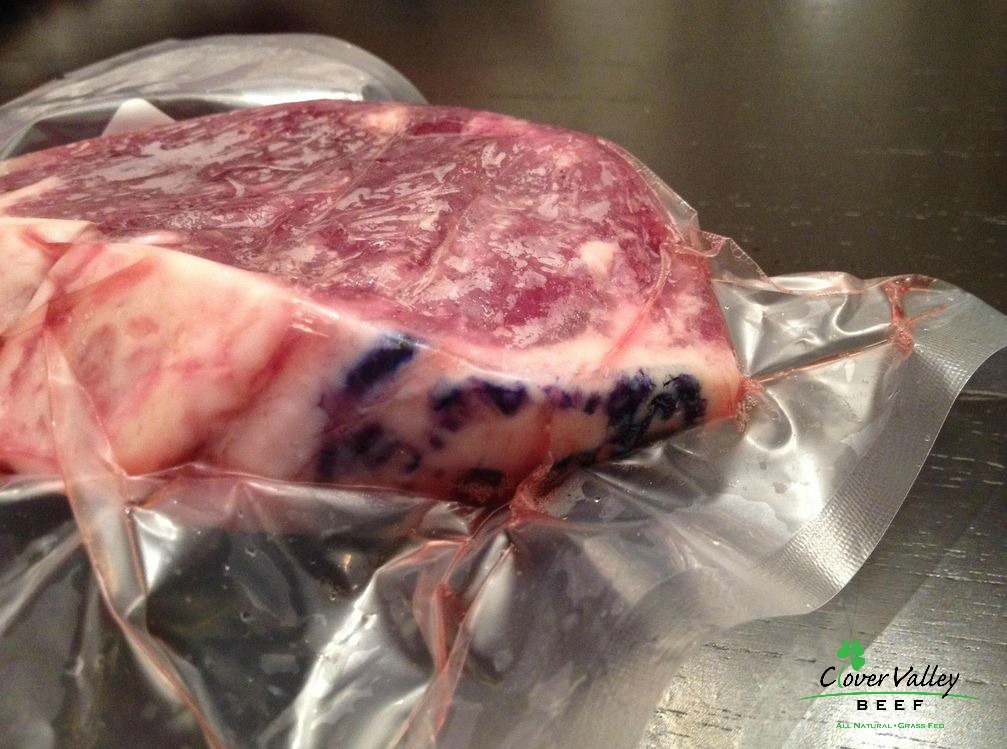
In a retail store, butchers often trim off the parts of carcasses with the stamp so consumers never see it. However, when you purchase a quarter, half or whole beef from our family farm, there is a chance you’ll see the stamp because of how our USDA butcher trims the beef.
In addition to the stamp on the carcass, a USDA stamp must be on every package of meat. The stamp also includes an official establishment number that is assigned to that processing facility by the federal government. The numbers are called “establishment numbers,” and they’re only good for one location. These numbers make it very easy to tell exactly where the beef was processed.
Beef that passes state inspection often has a symbol of the outline of the shape of the state.
Grading Beef: Prime, Choice & Select
Once beef passes inspection, it can also be graded for quality. Grading beef is optional and voluntary. The USDA’s Agricultural Marketing Service is the agency responsible for grading meat and poultry. Those who request grading must pay for the service (i.e. the farmer or the beef packer). Grading for quality means evaluation of traits such as tenderness, juiciness, and flavor of meat.
At Clover Meadows Beef, we occasionally have our beef graded, but not on every single animal because it’s a significant additional expense.
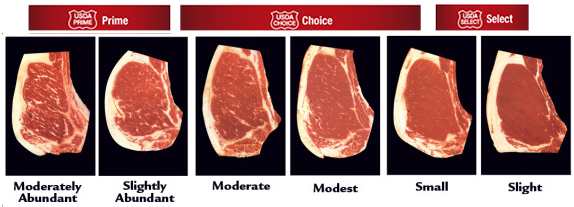
Within the meat grading system, there are eight quality grades. The grades in order from best to worst are Prime, Choice, Select, Standard, Commercial, Utility, Cutter and Canner.
Typically, consumers are most familiar with the top three grades: Prime, Choice and Select.
Standard and Commercial grades of beef are typically sold as store brand meat. The final three grades of beef – Utility, Cutter and Canner – are rarely sold at retail and are used to make ground beef and processed products.
Prime Graded Beef
Prime Beef comes from well-fed livestock and it has abundant marbling (i.e. fat within the beef). Grain-finished cattle have more marbling than grass-finished beef. You usually find Prime Beef at restaurants and hotels. It’s known for being full of flavor, and very tender and juicy. Only about 2 percent of today’s beef is of the highest USDA grade, or prime, which, has the highest level of marbling.
Choice Graded Beef
The most widely available grade of beef is Choice graded beef. Choice Beef is very high quality, but has slightly less marbling than Prime. It is very tender and juicy. About 50 percent of beef is graded choice by the USDA.
Select Graded Beef
Select Beef is typically leaner than the higher grades. It has less marbling, and also lacks some of the juiciness and flavor of the higher graded meat. The USDA grades about 21 percent of beef with the select grade.
How are beef grades determined?
When the USDA grades beef, they look at two main qualities: 1) quality grades for tenderness, juiciness and flavor; and 2) yield grades for the amount of usable lean meat.
To determine a beef grade, the USDA grader looks specifically at the amount of marbling in the ribeye muscle between the 12th and 13th ribs. Based on that one location of the cow, they can then determine if the beef in the entire cow is Prime, Choice or Select. The reason this works is be marbelization is responsible for giving beef its tenderness and added flavor.
In addition, beef is graded on the maturity (or age) of the animal. As cattle mature, their meat gets tougher and leaner. Since the tenderness of beef is directly affected by cattle’s age, the USDA considers the animal’s age.
In addition to quality of beef, the USDA also looks at the yield grade – or the amount of usable lean meat on the carcass – when grading beef.
What beef grades do not mean
The USDA does a great job grading beef, and they are always evolving and improving. However, it’s important to note that some factors that many consumers now consider important do not go into the grade. These factors include the animal’s diet (grass fed vs. grain finished), the cut, and how the animal has been raised (pasture raised or not).
A side note that surprises many of our customers is that grass-finished beef will never be Prime Beef. The reason for this is because Grass finished beef are more lean so they don’t meet the USDA’s Prime Beef requirements for tenderness, juiciness and flavor.
One more thing!
Do you want to learn more about beef? Join our weekly e-newsletter where we share farm happenings, recipes and beef availability. Sign-up and get a cheat sheet with 9-must-ask questions before buying beef directly from a farmer. Or, we have an entire ebook about beef that goes through purchasing and preparing beef from a cattle farmers perspective.
Here are a few other links you may like:
- What everybody ought to know about beef cuts
- What Beef Labels Mean
- Buying a Cow. How Much Beef Is It?
- 7 Steps to Grilling a Steak to Perfection
- What Do Cows Eat
- Easy Beef Brisket Recipe (oven-roasted)
- The Best Farm Books for Kids
Disclosure: This post contains affiliate links. This means if you click on the link and purchase the item, we will receive an affiliate commission at no extra cost to you. All opinions are our own and we only recommend products that we truly believe in.
We participate in the Amazon Services LLC Associates Program, an affiliate advertising program designed to provide a means for us to earn fees by linking to Amazon.com and affiliated sites. See our disclosure policy for more details.


Nice to Meet You!
We're Matt & Jessica, fifth-generation cattle farmers & the owners of Clover Meadows Beef. Good food starts with knowing where it comes from. On our blog, you'll find easy beef recipes, cooking tips, stories of how we raise our cattle, and how to buy farm-fresh beef locally. Our goal is to make cooking beef easy so you feel confident cooking any cut of beef in your home kitchen.